
Learning to Listen and Communicate
Percussion Orchestra Team Building invites participants to pick up an instrument — drums, handcrafted instruments, or even their own hands — and create music together. While it may look like just playing music, this activity is a powerful experiential learning tool for developing communication, collaboration, and emotional expression within the team.
In this activity:
*Teams learn to listen actively, synchronize with others, and communicate through rhythm.
*Participants step out of their comfort zones, exploring their creativity while contributing to a shared goal.
*The orchestra becomes a metaphor for the company, where every “instrument” (team member) has a role, and harmony is achieved only through collaboration.
Key benefits:
*Team Alignment and Coordination – Each member’s contribution matters for the collective success.
*Communication and Emotional Expression – Music facilitates connection, understanding, and empathy among participants.
*Stepping Out of Comfort Zones – Encourages confidence, engagement, and creativity.
*Experiential Learning – Reinforces the importance of teamwork in a fun, memorable, and impactful way.
Why choose it?
Because it transforms music into a tool for team growth, helping participants understand their role in the group while developing harmony, trust, and collaboration in a unique, engaging experience.
From Sound to Team Alignment – The Process of Music Team Building
At the start of the activity, participants are introduced to the musical language, giving them time to familiarize themselves with rhythm, sound, and their own expressive potential. This initial phase helps overcome shyness, self-doubt, and personal barriers, creating a safe space for participation.
Next, the team moves into voice and sound exercises, which foster strong relational dynamics, both in collaboration and as individuals within the group context. Whether using voice, musical instruments, crafted instruments, guitars, percussion, choirs, or opera, the ultimate goal is to create something unique together — like a song — that reflects the collective effort of the team.
Stages of the Music Team Building process:
*Awareness of your role – Understanding individual contribution within the team.
*Alignment and collaboration within your role – Working effectively with others toward a common goal.
*Motivation of the group – Inspiring energy, engagement, and shared responsibility.
*Harmony and integration between organizational functions – Strengthening cohesion across diverse roles and perspectives.
Key skills developed during the activity:
*Collaboration and mutual listening
*Effective communication and coordination
*Harmony and group alignment
*Energy, focus, and commitment
*Emotional involvement and engagement
By combining musical creativity with experiential learning, this approach produces a high level of emotional engagement, helping teams not only perform in sync but also internalize key collaborative skills that carry over into everyday work life.
Would you like to “tune” your team?
Group Spirit and Sharing of Values – The Power of Rhythm
In Music Team Building, creating music requires just four essential elements: time, rhythm, melody, and harmony. Once combined, these elements form the foundation for a collective symphony. The primary goal is to share the rhythm and create harmony — both individually and as a group — while fostering group consciousness and fun.
As participants play together, they form a collective voice that emerges in unison, symbolizing a team that is united, aligned, and collaborative. Regardless of prior musical experience, everyone contributes to the group, enriching each other’s experience and celebrating community through rhythm and music.
Why this activity works:
*Inclusivity: People of all ages, cultures, and skill levels can participate.
*Collaboration: Everyone contributes to a single, cohesive musical outcome.
*Universal language: Rhythm and percussion transcend boundaries of age, religion, race, and culture.
*Relationship-focused: The quality of the music reflects the quality of team relationships rather than individual skill.
Keywords of the event: cooperation, collaboration, unity, shared energy, and joy.
The music created becomes a living entity, expressing passion, connection, and collective achievement, showing how shared experiences can transform a group into a truly aligned and harmonious team.
Drum Circle – Improvisation, Rhythm, and Team Harmony
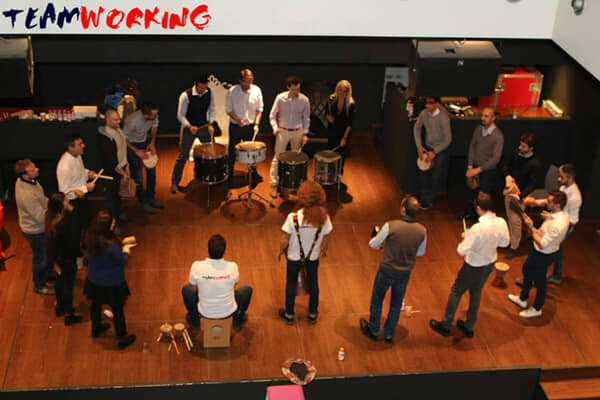
The Drum Circle is a dynamic, inclusive musical activity where participants gather in a circle to play percussion instruments and drums of all kinds. This is improvisation at its finest — not a rehearsal for a performance or show — allowing the group to explore rhythm, creativity, and collaboration in real time.
Key features of the Drum Circle:
*Participants: Can range from a small group to up to 100 people, making it adaptable to any team size.
*Equality: There is no hierarchy — everyone contributes equally, and every voice matters.
*Collective experience: The main goal is to share rhythm and create harmony, forming a collective voice that emerges from the group as they play together.
Full inclusion: There is no audience, no “right” or “wrong” notes, and everyone is welcome. Freedom of expression is central, allowing participants to fully engage without fear or judgment.
Guided by a coordinator: A professional facilitator ensures the development of group spirit, connection, and synchronization while respecting improvisation and creative freedom.
Why it works for teams:
The Drum Circle teaches participants to listen, synchronize, and collaborate, emphasizing that team harmony and collective output are more important than individual performance. It’s a fun, engaging, and highly inclusive way to strengthen team cohesion, trust, and alignment.
How do we realize the Percussion Orchestra?
To create the Percussion Orchestra of your company, we combine a variety of musical instruments from different world traditions with the most important instrument of all: the human voice. Regardless of the instruments or musical metaphor used, the goal remains the same: to create something unique together, reflecting the collective effort of the team.
Just like in the workplace, each participant has a role and will experience the importance of their contribution within the group.
Key aspects of the instruments used:
*Instruments are played by beating, rubbing, or shaking, and never in isolation — each one requires the support of others, emphasizing interdependence.
*The activity encourages listening, complementarity, and collaboration, as each member’s input directly affects the group’s harmony.
Adaptability for different group sizes:
*Small groups: Easier to focus on listening, understanding, and participation, allowing deeper interpersonal dynamics.
*Large groups (hundreds of participants): The emphasis shifts toward a sense of belonging, alignment, and collective energy, reinforcing team cohesion and shared purpose.
What Teams Learn from Percussion Orchestra Team Building
The Percussion Orchestra is not just about making music — it is a powerful experiential training tool that develops both individual and collective skills.
Key learnings for participants:
*Listening: Learning to pay attention to others, synchronize, and respond to the group.
*Trust: Relying on teammates to maintain rhythm and harmony, fostering confidence in each other.
*Rhythm and coordination: Understanding how individual contributions fit into a larger system.
*Attention and focus: Heightened awareness of the group dynamics and collective output.
*Engagement and involvement: Moving participants from initial shyness or reserve to full participation.
*Fun and group cohesion: Creating shared joy and a sense of unity through a collective musical experience.
At the beginning of the activity, participants may feel hesitant, reserved, or unsure. Gradually, as the ensemble develops, they become more open, confident, and fully involved. By the end, the happiness, complicity, and shared energy are clearly visible, reflecting not only the success of the musical performance but also the strengthened bonds and alignment within the team.
Organize your next teambuilding event with us!