
Team Building or Incentive?
Team Building and Incentive: two ideas that get confused
Training and incentive activities inside companies are more and more common. There’s still a fair amount of confusion, though, even about the most important ideas. That’s why this piece takes on the subject of team building versus incentive: what team building means, what an incentive means, how the two relate, when they meet and when they have to be kept apart.
We’ve already given several pages to explaining what team building is, telling you how to organise a team building and offering some ideas for corporate team building. So we won’t go over that ground again here, beyond a few preliminaries.
Team Building: what is it?
Team building means the set of activities run with groups of employees to improve the dynamics of communication and teamwork. The most recent tendency in team building is to use the instruments of what’s called experiential training. Where traditional classroom training teaches through words, experiential training teaches through real situations the participants live through.
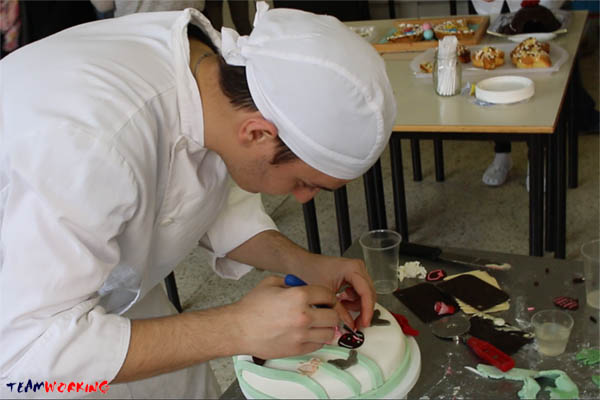
What kind of situations does experiential training create? Every kind: from cooking to survival techniques in the desert, from making a painting to a treasure hunt through the streets of a city. What they have in common is that they take the team out of the usual office routine. That makes it possible to check, exercise and improve communication, problem solving and the way the group works together.
Outside the office walls people are more inclined to relax and to get involved, and so they discover new characteristics and abilities in themselves and in their colleagues.
Incentive: what is it?
The word incentive usually sits next to the word trip: incentive travel, incentive tour, incentive trip are the most frequent expressions. It’s a reward trip that takes the participants to a fine destination for recreational activities, meetings and training. The purpose of an incentive programme is to create a unique and exclusive experience that will stay in the memory and strengthen the emotional bond with the company.
A corporate reward trip can be reserved for:
- senior managers, whom the company wants to keep through a high-end incentive;
- salespeople being rewarded for having reached the targets the company set;
- employees among whom the company is looking for candidates for a promotion, and whom it wants to motivate to produce more;
- the most important clients, to give them a positive picture of the company and of future collaboration, present new products or services, show them where things are made, and build personal relationships alongside the working ones.
Travel agencies and team building companies in the Gulf deal constantly with incentive groups arriving from abroad. Saudi Arabia is the newest of those destinations by a long way: until 2019 there was no tourist visa at all, so a reward trip here could not be organised even if you wanted one. That is most of the argument for coming now. The flights, the hotels and the winter are the same as the rest of the region, and almost nobody in your company has been.
What the newness costs is depth. Riyadh and Jeddah are well served; the rest of the country is not, so a programme built outside the two cities needs more lead time and has fewer fallbacks if something moves. And one practical thing that changes the shape of an evening: alcohol is not served in Saudi Arabia. An incentive dinner here is built around the food, the setting and what happens at the table. It is a different plan from the one that works in Dubai, not a smaller one. We say this before the quotation rather than after.
Incentive trip: which activities to propose?
Which activities can be part of a corporate incentive trip? In choosing, you have to allow for the fact that many participants will bring a partner or another member of the family. The purpose of building loyalty is pursued through shared experiences that leave pleasant memories. A company hopes to find more willingness later, including towards sacrifices of free time, in somebody who was rewarded with an experience they shared with their partner.
The programme has to be organised so that it’s interesting for everyone, keeps people occupied, and still leaves room for rest and above all for people to talk to each other.
Activities tied to the company
An incentive trip often has an official part. It might be:
- A meeting or a convention
- A visit to the company’s own spaces or to a production site.
Why run a team building during a corporate meeting?
In a treasure hunt designed as a team building the attention goes on problem solving, on effective interaction inside the team and on the contest between teams. In an incentive, the play and the culture of the place carry far more weight.
Discovering the city
An incentive programme lets the participants discover the city they’re visiting through cultural activities, and through rare and exclusive experiences. The point is to make the most of the destination by showing the best of it, which in turn reflects well on the company. What can you propose?
The classic visits to the main landmarks, and also more original occasions. A hunt built on the Masmak fort and the raid that started the modern state, an adventure among the dunes at sunset, an interactive tablet game through the lanes of Al Balad in Jeddah, a route following the caravans that carried incense north through what is now AlUla: those are only some of the things that can be built.
The best known museums of the city, and also the more particular or thematic exhibitions. Genuinely exclusive experiences can be arranged. An example? Dinner at a museum: some venues can host a gala dinner in an unusual and refined setting, in the middle of the collection. And think what a murder mystery dinner becomes when it’s set among the exhibits.
An incentive programme obviously includes lunches and dinners in fine restaurants. They can be enriched with actors, as in a murder mystery dinner, or with a cooking class or a show cooking. Participants, especially the ones arriving from abroad, are delighted to discover the region’s culinary traditions, and Italian ones, in a real professional kitchen.
Living an adventure
Saudi Arabia is not only cities. There is the Empty Quarter, the escarpment they call the Edge of the World an hour and a half from Riyadh, the sandstone valleys around AlUla, the Asir mountains in the south-west where it is green and cool enough for a jumper in August, and the Red Sea along the whole western coast. All of that can be used to create memorable experiences for the guests of an incentive. Depending on the season, the destination and the budget you choose between a great many options. What they have in common is that they are set in nature rather than (only) in a city.
In winter a day among the dunes, in the cooler months a walk through a wadi with the mountains on both sides. For the more adventurous and physically active groups, it gets enriched with a Survival-style adventure. Even here, though, the difference from a Survival Training run as a team building is considerable. Where the training version has demanding timed challenges in a contest between teams, with plenty of adrenaline, the incentive version is an experience of discovery and curiosity. Participants get taught the survival techniques and in some cases get to try them, all in a relaxed and playful setting.
The Red Sea is the other half of the country, and it is the part visitors do not expect. The reef starts a few metres from the shore, which makes a first dive or a morning of snorkelling something a whole group can do together instead of an excursion for the two people who already have a licence.
The coastal venues have a great deal of charm too, though you have to allow for how busy they get in the high season and choose either an exclusive destination or a quieter time. A themed treasure hunt works well here, built on the pilgrim ships and the merchant families who made Jeddah what it is.
Cultural experiences
The region offers plenty to people who prefer a cultural trip to one spent outdoors. The choice of activity depends on the participants’ interests, the average age and the make-up of the group. For everybody, though, there’s a range of experiences worth having. You can plan:
Taking an incentive group to a concert at Maraya, in AlUla, is a luxury that leaves a mark. The hall is clad entirely in mirrors and disappears into the valley around it, which does half the work before anybody plays a note. An extra touch of class? Dinner there.
An evening of classical music or a rock concert, depending on what the participants like, which the organiser of the trip has to find out in advance. The venues built for the Riyadh and Jeddah seasons take audiences on the scale of an arena. What is on gets announced late and books up fast, so it is worth asking what is available for your dates rather than fixing the dates around something.
Sport has become part of what the country offers, and if something is on inside your dates it can be worth adding to an evening. We would not build a programme around a fixture, though: dates move, and a trip that depends on one evening has nothing left when that evening shifts.
When what surfaces deserves an afterwards
An activity surfaces a great deal about how a team communicates, decides and works together, and sometimes what surfaces deserves more time, more depth and a method. That is where a Team Coaching path can begin: a different road, to be taken only if it is needed, to turn what the day made visible into a new way of working together.
Let’s talk about your next team building
You don’t need to have picked a format yet. Tell us what you want your team to take home, how many of you there are and where you’ll be, and we’ll do the rest: within 24 hours you get a considered proposal for your case, with the formats that hold up against your numbers, and what each one leaves the team the day after.
Prefer to talk? · info @ teambuildingsaudi.com